Land Clearing Cost per Acre (2026): Prices by Method, Vegetation, State and Lot Size, with a Cost Calculator
I have priced acreage since 2019, and the bill always comes down to the machine and the ground. The numbers hold in all 48 contiguous states. Forestry mulching runs $1,000 to 2,500 an acre for light to medium cover and $2,500 to 4,000 for dense cover. Full clearing to dirt runs $2,500 to 6,000 an acre. Marisol emails a budget range the same day. Call (888) 709-7985 or send the form.
- 48 contiguous
states - Insured
crews - Same-day
budget range
48 statesContiguous coverage
$2,500–3,200Skid steer mulcher, per day
60 milesTransport included
Same dayBudget range by email
Land Clearing Cost Calculator and Estimating Formulas
Calculating the cost of land clearing requires looking at four specific inputs instead of guessing. Our estimators use a simple formula to determine the overall cost: tract acreage multiplied by the vegetation density factor, adjusted for the chosen machinery and local terrain modifiers. Terrain modifiers add daily costs for steep grades, surface rock, or saturated soils.
Consider a 2-acre clearing project with medium brush and scattered small trees. The daily rate for a skid steer mulcher is $2,500 to 3,200. The total time required is 1.5 days. If you request root extraction, root removal, and site grading instead of mulching, machine time increases to 2 full days on a crawler tractor or excavator, bringing the total expense to $5,200. Call (888) 709-7985 to clear up budget questions before clearing work begins.
Open the full land clearing cost calculatorHow Much Does It Cost to Clear Land? Average Cost per Acre
When clients ask about the average cost to clear land, the price ranges from $1,000 to $6,000 for each acre. Call (888) 709-7985 for a free estimate on your parcel. Landowners frequently ask how much does land clearing cost for a residential parcel. Simple brush clearing and understory thin-outs fall on the low end, while clearing a single acre of heavily forested land down to bare dirt sits at the top end. Land management projects that preserve topsoil using mulchers keep labor costs down compared to traditional cut-and-transport work. To clear an acre of land with light cover costs significantly less than grubbing mature timber down to bare soil.
Call (888) 709-7985 or send the form to review your site layout with an estimator. On our jobs, we break prices down into fixed day rates so you know exactly what machine is running and for how long. The table below outlines standard pricing across common vegetation levels and equipment setups.
| Clearing Scope | Vegetation Type | Price Range an acre | Typical Equipment Used |
|---|---|---|---|
| Light Clearing | $1,000 - $1,800 | Bush hog, skid steer brush cutter | |
| Medium Clearing | $1,800 - $2,500 | Skid steer forestry mulcher | |
| Heavy Clearing | Thick brush, hardwoods, cedar, juniper up to 12 inches | $2,500 - $4,000 | 300-hp dedicated forestry mulcher |
| Complete to Dirt | Heavily wooded, mature trees, stump extraction | $2,500 - $6,000 | Dozer, excavator, root rake, haul truck |
Every land clearing project carries specific site variables. Level land with soft soil allows machines to clear faster, keeping total invoice costs lower than steep, rocky hillside parcels.
Cost to Clear 1/2 Acre, 1 Acre, 2 Acres, 5 Acres, and 20 Acres
Tract size changes unit economics. Small parcels carry fixed mobilization expenses, meaning to clear half an acre costs more per square foot than clearing a large pasture. Below is how project pricing scales across common parcel sizes.
Clear half an acre
$2,500 to $3,200. A standard suburban build lot with light cover takes 1 day for a crew to clear, mulch, or pad-prep. Mobilization takes up a higher percentage of the invoice.
1 acre
$1,500 to $4,500. A clearing project on a single acre depends directly on stem count and trunk diameters. Light brush takes 1 day; wooded land can take 1 to 3 days.
2 acres
$3,000 to $7,500. Small acreage homesites often combine forestry mulching on building envelopes with selective clearing along driveway paths and fence lines.
On 5-acre parcels, production efficiencies take effect. High-horsepower equipment clears larger zones near house pads quickly, bringing down the average cost to clear an acre.
Large pasture restorations and acreage clearings use dedicated 300-hp mulchers running full days to maintain high output speeds.
Regardless of acreage, equipment transport is included inside 60 miles of our crew's nearest yard. Beyond 60 miles, transport fees are stated up front on your estimate.
Land Clearing Rates per Hour vs. per Acre vs. per Day
Contractors bill for land clearing services in one of three ways: hourly rates, flat per-acre prices, or fixed day rates. Hourly rates for a dozer or excavator with an operator run $150 to $200 per hour, usually carrying a 4-hour to 8-hour minimum trip cost of $1,000 to $1,500. While hourly billing works for small, isolated jobs like digging out three stumps, it leaves total land costs open-ended on larger tracts.
Bidding per acre depending on vegetation works well on uniform acreage with steady stem density. However, if hidden surface rock or wet lowlands slow down the machinery, per-acre quotes can create friction between owners and operators. I've priced jobs under all three models, and clear day-rate pricing protects both parties best. A standard skid steer mulcher runs $2,500 to $3,200 per day, while a heavy 300-hp dedicated mulcher runs $3,800 to $4,500 per day plus transport. Day rates give landowners a predictable cost structure based on proven production logs.
Cost by Clearing Method: Forestry Mulching vs. Dozer vs. Excavator and Haul-Off
The chosen clearing technique determines equipment needs, total labor hours, tree removal needs, and how organic material is handled. Selecting your method for clearing the land determines whether material leaves in dump trucks.
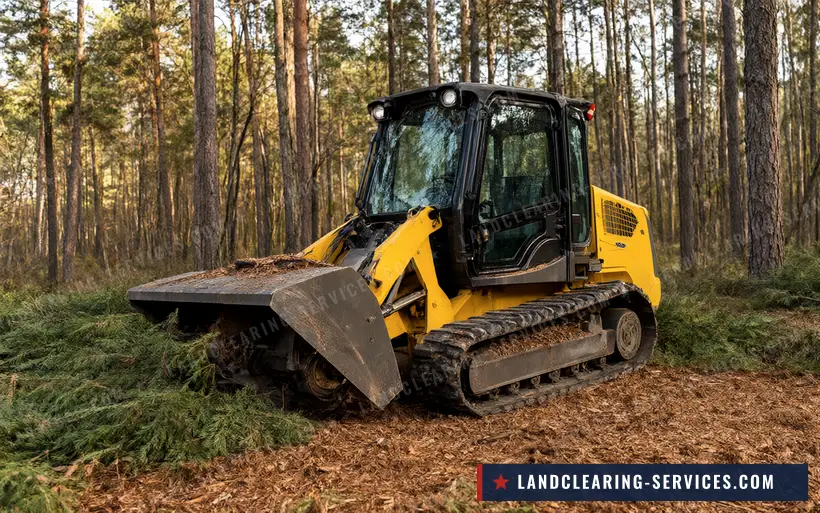
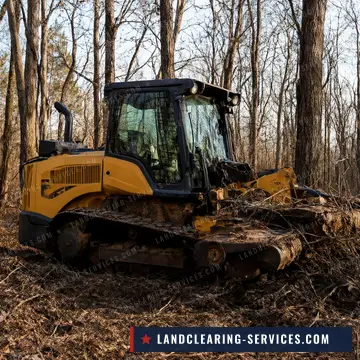
Forestry mulching uses a specialized rotor cutter to shred standing brush, saplings, and trees into fine mulch in a single step. Mulch stays on the ground, eliminating burning permits, trucking fees, and topsoil loss. Costs range from $1,000 to $4,000 per acre depending on wood density. This environmentally friendly approach protects roots of retained trees and prevents ground erosion control issues.
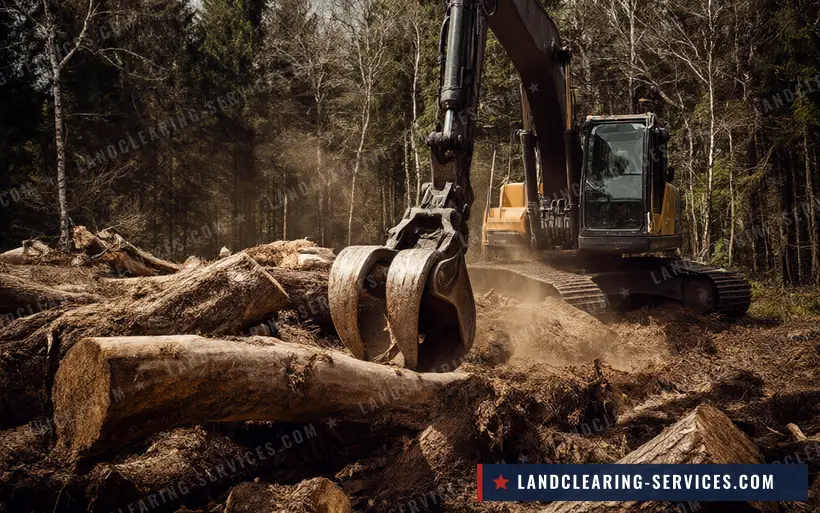
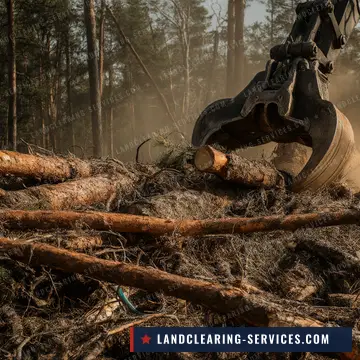
Traditional clearing relies on a heavy bulldozer or excavator to push trees down, pull roots out, and stack debris into burn piles or debris containers. Dozer work runs $2,500 to $6,000 per acre depending on how heavily forested land is. Grubbing stumps and grading bare dirt requires additional machine time. If burning is banned, debris removal using trucks adds $600 to $1,300 per load. High transport costs make push-and-cart expensive to clear compared to on-site mulching.

Cost by Vegetation: Brush, Small Trees, Wooded Land, and Mature Timber
Vegetation type drives machine speed faster than almost any other site factor. Soft brush lets a cutter travel at two miles per hour, whereas dense hardwood or thick cedar slows equipment down. Costs vary widely based on what grows on the tract.
Light brush and weed cover
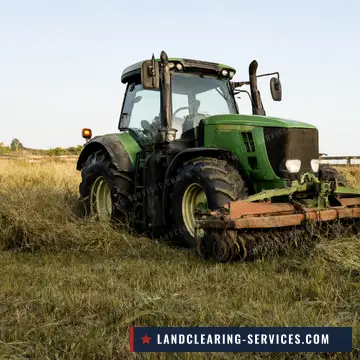
$1,000 to $1,800 for each acre. Thin thickets of blackberry or small shrub patches yield quickly to standard skid steer attachments.
Managing heavy growths of privet, buckthorn, autumn olive, or multiflora rose requires mulching teeth that shred dense stem networks.
Mixed thickets and scrub evergreen
$2,500 to $3,800 for each acre. Invasive species like eastern red cedar, pinyon-juniper, chaparral, and palmetto require high-flow mulchers to handle abrasive foliage and dense wood.
Heavily wooded land and mature trees cost $2,500 to $6,000 per acre. Hardwoods, mature trees, or thick pine stands demand heavy felling passes, root removal, and multi-machine setups.
Granite is concrete that nobody poured. Identifying target vegetation and specific trees early ensures crews arrive with the proper teeth for clearing trees and brush efficiently.
Lot Clearing Cost for a New Home
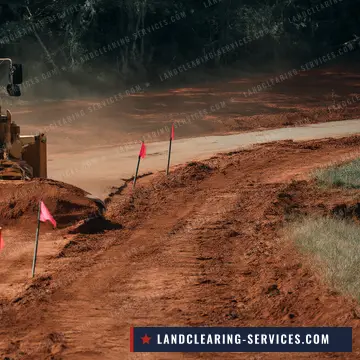
Preparing a residential building lot requires specific site work beyond simple brush clearing. Home builders require a flat pad, cleared access paths for concrete trucks, and standard safety margins around utility connections. A lot with light cover takes 1 day and costs $2,500 to $3,200 for standard mulching.
Removing large trees and shrubs near neighboring structures adds manual chainsaw work and rigging time.
What Drives the Price Up: Slope, Access, Haul-Off, Stumps, Permits, and Ground Conditions
Every estimate states what it takes to clear the ground before a machine moves. Field estimators know several factors that influence land clearing costs when ground obstacles threaten equipment or reduce hourly production speeds. Understanding these cost factors helps prevent invoice surprises when determining the cost of clearing land.
- 01
Access
Narrow driveways or low overhead power lines limit heavy transport trailers, forcing crews to clear one section at a time with smaller gear.
- 02
Stump removal
Leaving mulched stumps flush with the dirt keeps costs down. Extracting root balls or paying for stump grinding at $3.50 to $5 per inch ($150 to $200 minimum per stump) increases labor costs and disposal fees.
- 03
Trucking fees
When local ordinances ban burning because land generates substantial debris, trucking away debris removal loads adds $600 to $1,300 per dump trip.
- 04
Permits
Municipal tree protection permits or local erosion control guidelines require securing permits before you can clear, adding administrative steps before equipment unloads.
- 05
Rock and hard pan
Ledge rock, granite outcroppings, or buried caliche break teeth, which affects land clearing budget planning.
- 06
Wet or frozen ground
Saturated lowlands force equipment to run on mats or wait for dry weather, adding time. Conversely, frozen ground from December to March in northern states provides a stable base that mulchers travel on easily, though excavators may take an extra day on frozen dirt.
Six Real Jobs and What They Cost
To demonstrate how site parameters dictate final invoices, review these six actual job logs from our project files. Each land clearing project reflects real-world equipment selection, production timelines, and regional soil conditions.
- Job log
Cherokee County, Georgia
$5,800We cleared 4 acres of dense Chinese privet and sweetgum saplings growing under loblolly pines last fall. Total cost: $5,800.
- Job log
Weatherford, Texas
$2,900One of our Texas crews processed a half-acre lot thick with invasive mesquite for a residential build. The job took 1 day using a track mulcher to shred stems down to ground level. Total cost: $2,900.
- Job log
Logan County, Oklahoma
$18,500A customer needed 20 acres of dense eastern red cedar pasture reclaimed for open grazing. We deployed a dedicated 300-hp mulcher for 4 full days to clear thousands of mature cedar trees. Total cost: $18,500 plus transport.
- Job log
Bend, Oregon
$4,600Cleared 2 acres of thick western juniper to create a wildfire defensible space zone around a mountain home. The job required 1.5 days of precision mulching and brush thinning. Total cost: $4,600.
- Job log
Lake County, Florida
$14,200Complete clearing of a 10-acre dead citrus grove. Crews used heavy dozers and excavators with root raking attachments over 3 days to push trees, pull root balls, and stack debris for disposal. Total cost: $14,200 plus trucking fees.
- Job log
Hudson Valley, New York
$3,100On a tract in New York, we cleared 1 acre of dense multiflora rose and invasive buckthorn during a frozen-ground January job. The hard-frozen soil supported the skid steer mulcher perfectly, finishing in 1 day. Total cost: $3,100.

Land Clearing Cost by State: Pricing Modifiers Across 48 States
Regional geography, soil types, and timber density cause land clearing prices to vary across the country. In high-growth states, common land clearing keeps equipment active year-round, while local permit guidelines alter operational steps.
states
Single-family permits, 2025 Census Building Permits Survey
- Texas140,579
- Florida111,173
- North Carolina65,303
- California57,739
- Georgia44,351
- South Carolina39,897
- Arizona33,371
- Tennessee32,068
- Virginia20,458
- Indiana19,877
- Washington17,780
- Colorado17,406
State building statistics illustrate where site clearing demand is concentrated. According to the Census Building Permits Survey for 2025 single-family units, high-volume permit states include Texas (140,579 permits), Florida (111,173), North Carolina (65,303), California (57,739), Georgia (44,351), South Carolina (39,897), Arizona (33,371), Tennessee (32,068), Virginia (20,458), Indiana (19,877), Washington (17,780), and Colorado (17,406). High development volume creates stable equipment availability, though regional ground rules shift job costs.
For example, clearing cost per acre in South Carolina ranges from $1,000 to $6,000 depending on vegetation. Western states like California, Colorado, Oregon, and Washington price defensible space clearing around homes per 100 feet of perimeter due to wildfire rules. Southwestern ground containing caliche or granite adds mechanical stress, while northern states from Minnesota to Maine experience winter seasonal shifts where frozen dirt adds time for excavation work but aids mulching. Our network maintains equipment crews across all 48 contiguous states to handle regional terrain specs.
EQIP Cost-Share: NRCS Brush Management Practice 314 in Plain Terms
Agricultural landowners and timber managers can offset land management expenses using federal cost-share programs. The Natural Resources Conservation Service offers financial support through the Environmental Quality Incentives Program, specifically under NRCS Practice Code 314 for brush management.
EQIP provides incentive payments per acre to control invasive plants like pasture cedar, mesquite, or buckthorn. Landowners must apply through their local USDA service center before clearing heavily overgrown acres. An NRCS conservation planner inspects the acreage, verifies invasive plant thickness, and establishes a management schedule. Once approved and funded, you hire an independent land clearing contractor to perform the mulching or clearing work according to spec, receiving reimbursement rates established by the program upon completion.
Are Land Clearing Costs Tax Deductible? Does Clearing Add Property Value?
Tax treatment for clearing expenses depends on how the real estate is used. For commercial real estate developers and residential home builders, land clearing costs are generally capitalized into the basis of the land rather than deducted immediately. Always consult a qualified CPA or tax professional to review your project's tax status.
In terms of property value, clearing heavily choked acreage consistently increases market appeal. Removing dense thickets improves physical access, reveals natural topography, improves fire defensibility, and prepares raw ground for immediate construction. Well-cleared parcels routinely command higher prices than overgrown tracts because buyers can envision building without factoring in unknown clearing liabilities that could cost as much as the land itself.
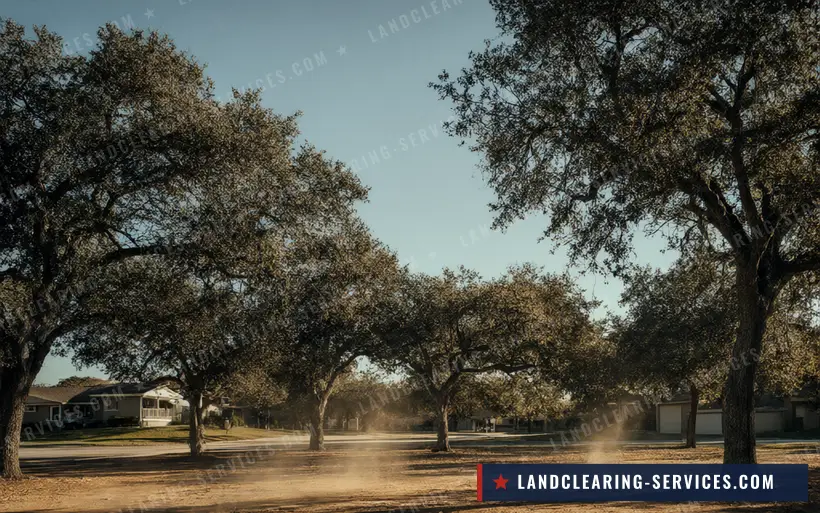
Get an Exact Quote for Your Land Clearing Needs
Stop guessing at clearing costs. Contact Clearline Land Services to receive an accurate, written price estimate based on fixed equipment day rates and realistic daily production metrics. What you expect to pay is written out before the machine unloads. Call (888) 709-7985 to clear your schedule and get a free estimate today. Marisol will email a detailed budget range the same day. Request a free on-site estimate with our local crew nearest your tract, anywhere inside 60 miles of our crew yards. Our fully insured crews deliver professional results without hidden fees or surprise invoices.
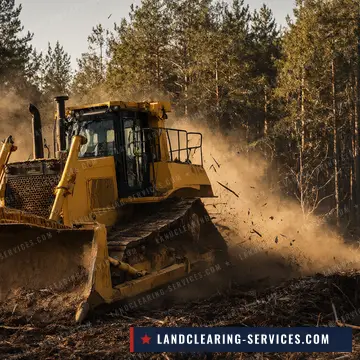 Land clearing
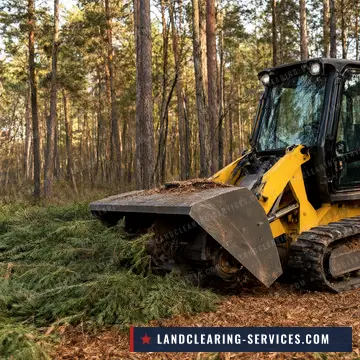 Forestry mulching
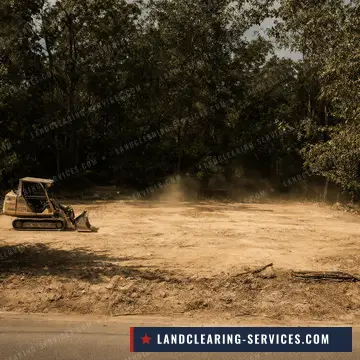 Lot clearing
 Brush clearing
 Tree clearing
 Stump grinding
 Site prep & dirt work
 Bush hogging