Land Clearing Services in Illinois: Common buckthorn Cleared on Lots and Acreage from Chicago Collar Counties to Southern Illinois
Our land restoration company in Illinois knows common buckthorn covers the understory, while deep black prairie loam traps heavy machinery after spring rain. I have priced brush projects across 11 states since 2019, and Minnesota buckthorn and local buckthorn are the same job with different roots. A skid steer mulcher runs $2,500 to $3,200 a day, transport included inside 60 miles of the yard. Our crews handle lot clearing, acreage, fence lines, and driveways from the Chicago collar counties to the south. Send the form or call (888) 709-7985. Marisol emails a budget range the same day and books the free estimate with the crew nearest you.
- 48 contiguous
states - Insured
crews - Same-day
budget range
48 statesContiguous coverage
$2,500–3,200Skid steer mulcher, per day
60 milesTransport included
Same dayBudget range by email
Forestry Mulching and Land Clearing Services in Illinois
We offer expert land clearing across this state in seven forms, and we price every job by the day rate or by the acre. Equipment designed for dense brush allows us to deliver usable land without hidden add-ons on the invoice. Our machinery efficiently shreds standing trees and brush into useful organic matter.
Forestry mulching
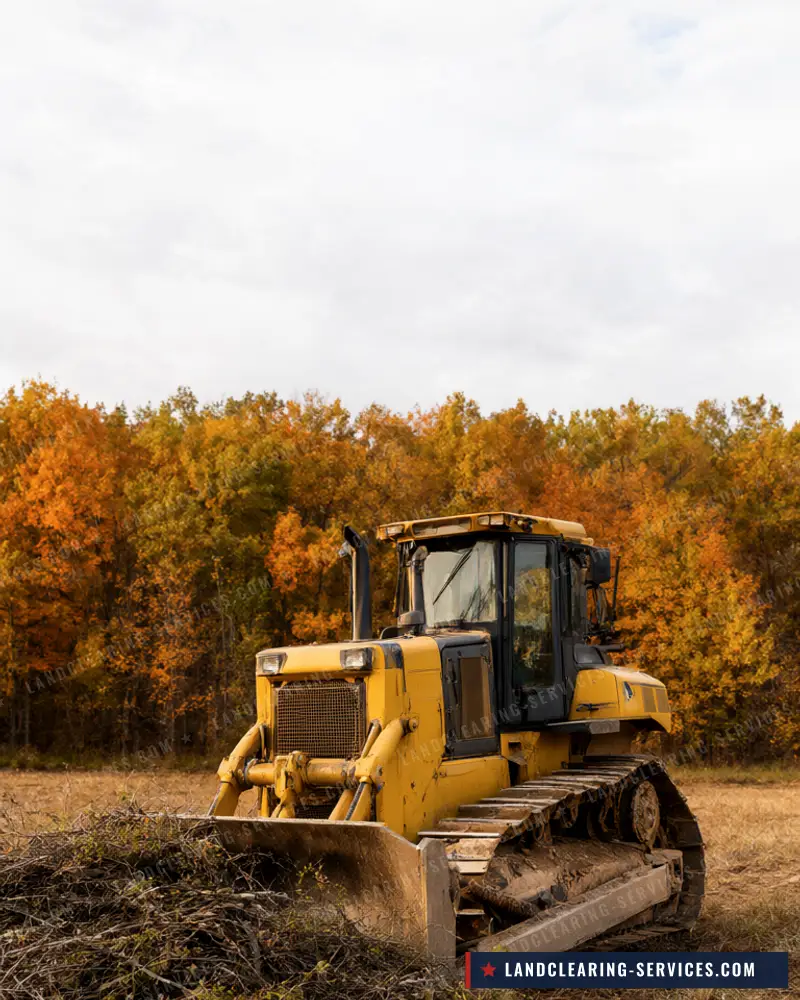
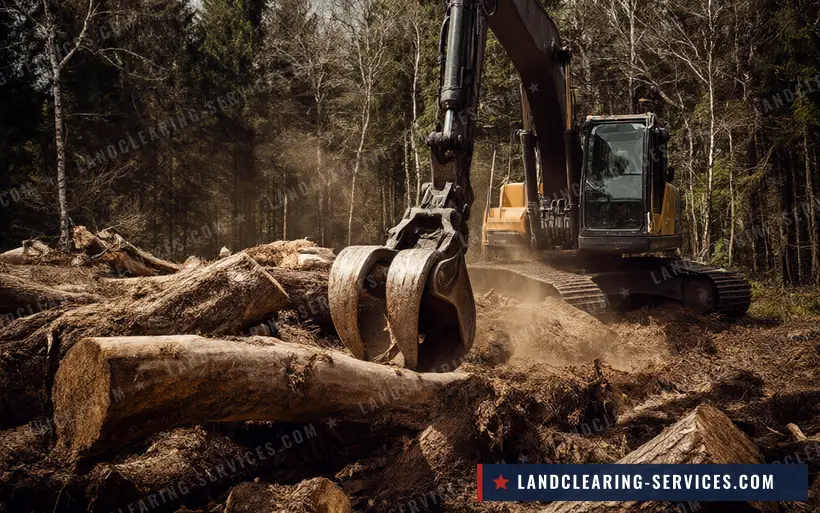
a single machine turns small trees, fallen trees, and sapling stems into a mulch layer that protects the soil. Our crews easily mow down thick brush during this process. Rates run $1,000 to $2,500 an acre for light to medium growth, and $2,500 to $4,000 for dense cover.
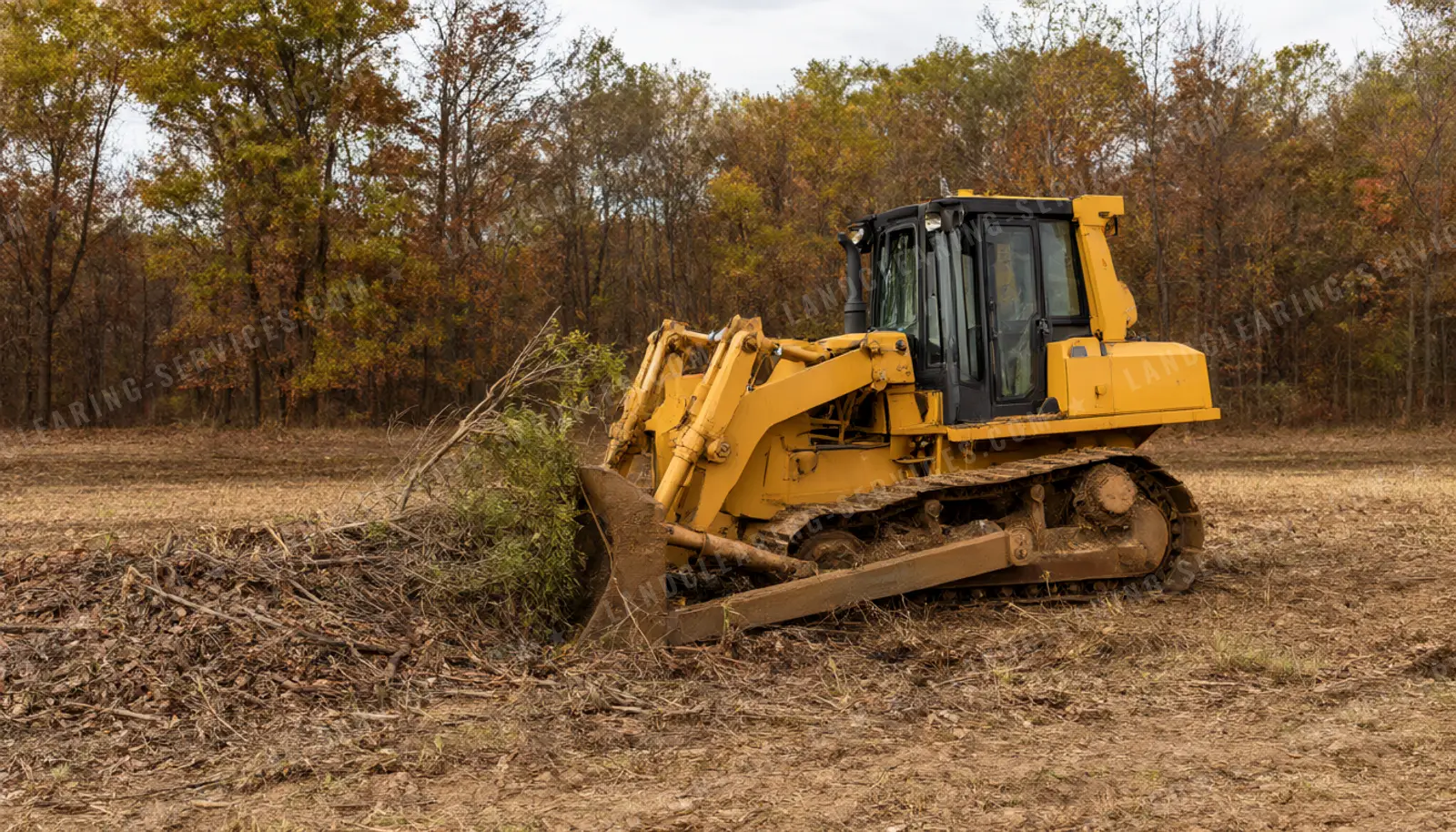
Traditional land clearing methods clear vegetation down to bare dirt with stumps grubbed, root-raked, piled, or hauled off. Full grading runs $2,500 to $6,000 per acre based on rock, slope, and haul distance.
Lot clearing
lot clearing for new home construction on a typical half-acre parcel takes one day on the skid steer mulcher at $2,500 to $3,200.
Brush clearing
targeting common buckthorn, bush honeysuckle, and autumn olive while keeping native oak and hickory standing.
Stump grinding
expert operators grind brush remnants and stumps below grade at $3.50 to $5 per inch of diameter, with a $150 to $200 minimum per stump.
Tree removal
selective tree clearing for commercial projects, residential expansion, or pasture reclaim. We remove trees and shred invasive species together across stands.
Site prep and driveway cutouts
building pads, access roads, and rough grading run $150 to $200 per hour with a dozer or excavator operator.
We do not pour concrete, drill wells, set septic systems, or demolish standing houses. Reliable land clearing experts tell you that before the trailer moves.

Land Clearing Near Chicago, Peoria, and the Bluffs
Prairie loam is black concrete when dry and grease when wet.
contiguous states
- 01
Chicago collar counties
heavy clay on moraines, dense buckthorn, strict municipal tree ordinances, and growth in Will, Kane, Lake, and McHenry counties. Here forestry mulching preserves native roots. Hauling or burning restrictions mean property owners rely on professional forestry mulching.
- 02
Central Illinois
deep black prairie loam surrounding Peoria, Bloomington, Springfield, and Champaign. Overgrowth thrives along drainage ditches, field borders, and fence lines. Field access requires dry summer ground or winter frost.
- 03
Metro East
river bottomlands and loess bluffs near St. Louis.
- 04
Southern Illinois
rolling timberland and rock outcrops through the Shawnee Hills. Mixed hardwood timber, eastern red cedar bluffs, and autumn olive thickets require high-horsepower forestry mulchers.
Every region sits inside a 60-mile service radius from our nearest yard. Transport past 60 miles is itemized as a separate line before work begins.
What Local Landowners Clear Most: Buckthorn, Honeysuckle, and Cedar
Every landowner with overgrown property faces common buckthorn, bush honeysuckle, and multiflora rose under oak and hickory. Left alone, these species overgrow native understories and choke out hardwood saplings.
Removing invasive brush requires knowing how plants respond to the head. Buckthorn, honeysuckle, and autumn olive sprout from the root unless treated, while cedar dies when cut below the lowest green branch. On a job in Hudson Valley, New York, last winter, we cleared dense rose and buckthorn on frozen ground in one day for $3,100 using a tracked mulcher. The mechanical process is identical on Illinois land: use forestry mulching to grind brush and small trees down to ground level, then manage regrowth. Selective clearing preserves oak and walnut timber while restoring open land and wildlife habitat. Trail cutting lets you enjoy your land again. Private landowners clear fence lines to take their land back from dense brush.
Land Clearing Cost in Illinois per Acre
Pricing in this state depends on tree diameter, thicket density, wet ground, and haul distance if material leaves the site. Here is the daily rate structure we use on local estimates.
Skid steer mulcher
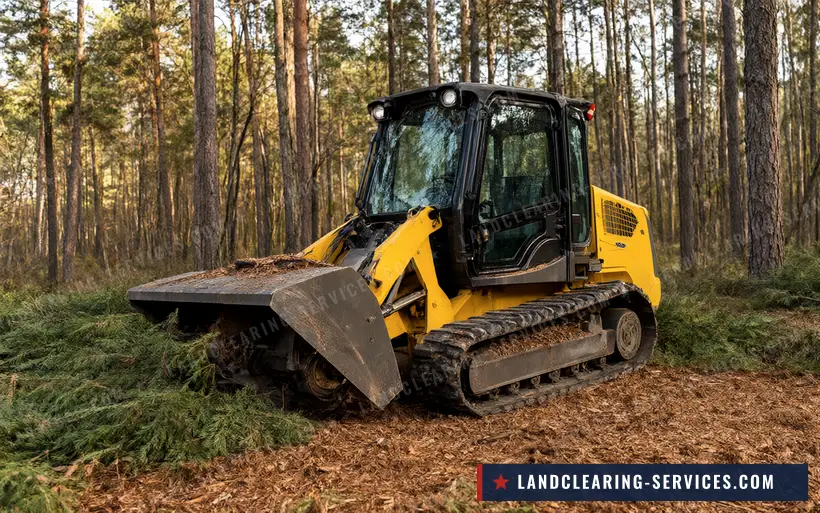
$2,500 to $3,200 a day, with transport included inside 60 miles of the yard. Handles brush and small trees up to 8 inches.
Dedicated 300-hp mulcher
$3,800 to $4,500 a day plus heavy transport. Clears dense timber and stems to 14 inches.
Forestry mulching per acre
$1,000 to $2,500 for light to medium buckthorn and honeysuckle; $2,500 to $4,000 for dense, overgrown timber.
Full clear to dirt (stumps grubbed, piled, or hauled, rough grade)
$2,500 to $6,000 per acre based on root depth, haul loads, and rock.
Dozer or excavator with operator
$150 to $200 per hour. Minimum trip runs $1,000 to $1,500. Haul-off costs $600 to $1,300 per load.
Here, light buckthorn allows similar daily production, while saturated prairie loam slows machinery and adds days. Our daily pricing is based on acreage and ground density. To get precise numbers for your acreage, call (888) 709-7985 or send the form to receive a budget range from Marisol the same day.
Land Clearing Cost Calculator for Illinois
Planning range from 2025–2026 national price data, adjusted to Illinois costs. Change any answer and the range updates.
Open the full land clearing cost calculatorBest Season to Clear Land in Illinois: Frozen Winter Ground vs Mud Season
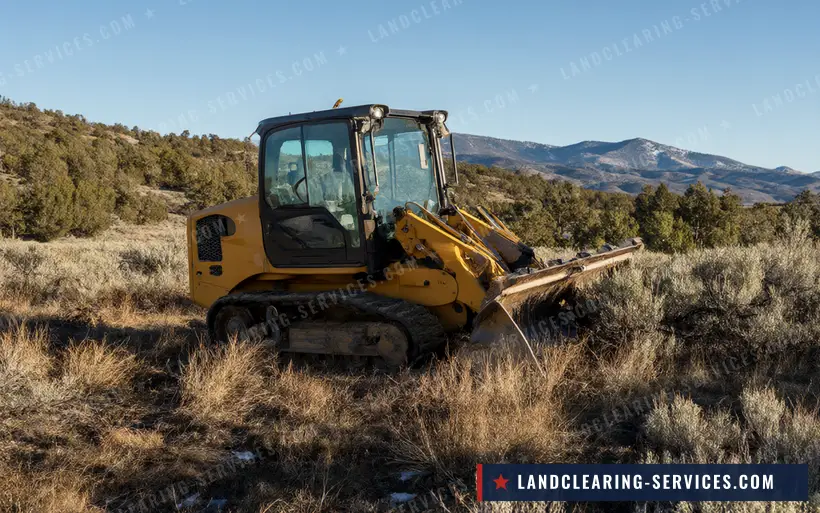
December through March provides prime conditions for forestry mulching services across central and northern counties. Frozen ground acts as a solid road, allowing heavy forestry mulchers to clear vegetation and remove trees over low spots without rutting prairie soil or damaging tree roots. A mulcher floats on frozen ground, converting standing buckthorn into a neat mulch layer that protects the soil structure underneath.
March and April bring mud season, when melting snow turns prairie loam into deep mud. Operating dozers during wet spring months creates deep compaction, frequently adding an extra equipment day to site cleanup.
State Permits, Burn Rules, Wetlands, and Tree Preservation Regulations
Working in an environmentally responsible manner requires following state environmental standards, county stormwater rules, and municipal codes.
- 01
Open burning regulations
The Illinois Environmental Protection Agency (IEPA) enforces air rules. Open burning of commercial or trade waste is illegal statewide. Landscape waste generated on site may be burned where generated unless restricted by local ordinances. Burning landscape waste is prohibited in counties over 400,000 population, including Cook, DuPage, Lake, Will, and Kane, making forestry mulching or haulage necessary.
- 02
Wetlands and stormwater protection
The US Army Corps of Engineers (USACE) Chicago District and Rock Island District regulate fill in wetlands under Section 404 of the Clean Water Act. County stormwater ordinances in DuPage, Kane, Lake, and McHenry regulate clearing or filling near floodplains and wetland buffers.
- 03
Municipal tree preservation
Towns across the Chicago collar counties enforce municipal tree preservation ordinances.
- 04
Utility line safety (JULIE 811)
State law under 220 ILCS 50/4 requires anyone excavating soil to notify JULIE by calling 811 not less than 2 business days and no more than 10 business days before digging begins.
- 05
This statutory penalty does not apply to invasive woody plants listed under the Illinois Exotic Weeds Act (17 Ill. Adm. Code 1100.30), including common buckthorn, glossy buckthorn, Amur honeysuckle, autumn olive, Russian olive, and tree of heaven.
Our operators verify property boundaries, review utility markouts, and work inside flagged wetland margins to keep your project compliant with state law.
Cost-Share Programs: NRCS EQIP Brush Management in Illinois
Private landowners seeking to eliminate invasive brush, manage overgrowth, and restore native oak habitat on agricultural or timber ground can access financial assistance through the USDA Natural Resources Conservation Service (NRCS). Environmental Quality Incentives Program (EQIP) funding, under practice code 314 (Brush Management), provides cost-share payments to reduce invasive brush like buckthorn, honeysuckle, and autumn olive.
To apply, property owners visit their local county USDA service center. An NRCS planner evaluates the site and writes a land management plan specifying target species, clearing methods, and post-clearing seeding requirements. Approval occurs on seasonal cycles, so applications should go in months before field work begins. Once approved, our crews execute mechanical brush clearing using low-impact mulchers to complete land restoration.
Land Clearing Companies by Illinois County and Metro
Illinois issued 10,821 single-family building permits in 2025 according to the Census Building Permits Survey. Residential land clearing and commercial development remain concentrated along key corridors where brush must be cleared before building begins.
- 01
Will and Kendall counties (Plainfield, Yorkville, Joliet)
Will County issued 1,797 single-family permits in 2025, leading the state, while Kendall County added 567 permits. Overgrown fence lines, dense buckthorn thickets, and former farm parcels require lot clearing and driveway cutouts for new construction. Land clearing in Will County near Will remains active year-round.
- 02
Kane and McHenry counties (Elgin, St. Charles, Algonquin): Kane County logged 1,389 single-family permits and McHenry recorded 919. Residential clearing across these moraines involves heavy invasive brush removal and municipal tree protection compliance.
- 03
Bloomington-Normal and Champaign (McLean and Champaign counties)
McLean County recorded 205 permits and Champaign logged 267. Work focuses on field edges, windbreaks, building pads, and utility companies lines.
- 04
Metro East corridor (Madison and St. Clair counties): Madison County recorded 323 permits and St. Clair logged 285. Projects include dense bottomland brush, overgrown residential parcels, and commercial site preparation near St. Louis.
Phase two will launch dedicated county and city pages. Today, our crews deliver fixed day rates across every county in Illinois, with simple transport lines for sites past 60 miles from our yard.
Send the Form, Get a Range the Same Day, Walk the Land with the Illinois Crew
Getting professional land clearing in Illinois involves three straightforward steps. Call (888) 709-7985 or fill out the online form detailing your county location, total acreage, and dominant vegetation. Marisol in our estimating office reviews project details and emails a budget range the same day. She books a free estimate with the crew lead nearest your location.
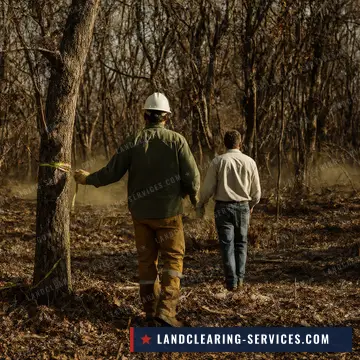
Our local crew lead meets you on site to walked it together. We confirm boundary lines, identify native trees to protect versus invasive brush to shred, check ground firmness, and inspect drainage pathways. You receive a final written price that states the daily rate, expected acres processed per day, and extra-day rules for rock or mud before the equipment unloads. Our insured crews execute the work using heavy iron. When your land is cleared, our team leaves a smooth layer of mulch. If you need trails through wooded parcels, clearing for residential expansion, or fence lines cleared, we help property owners clear your land safely and responsibly.
Land Clearing in Illinois Frequently Asked Questions
How much does land clearing cost per acre in Illinois?
Forestry mulching for light buckthorn runs $1,000 to $2,500 per acre, while dense woodland mulching costs $2,500 to $4,000 per acre. Full clearing down to bare soil with stump removal ranges from $2,500 to $6,000 per acre depending on root depth, haul-off loads, and ground wetness.
Do I need a permit for clearing in Illinois?
State permits are not required to cut brush on private land. However, burning debris requires checking Illinois Environmental Protection Agency air rules, and burning landscape waste is prohibited in counties over 400,000 population. Work near wetlands requires USACE Section 404 and county stormwater review, while collar county towns enforce tree codes.
Can I burn brush piles after clearing land in Illinois?
Commercial trade waste burning is illegal statewide. Private landowners may burn landscape waste generated on-site only in rural areas where local ordinances permit it. In populous collar counties, burning landscape waste is banned, making wood mulching or off-site haulage the standard option.
What is the best time of year to clear vegetation in Illinois?
Winter from December to March is ideal for forestry mulching because frozen ground allows tracked machinery to shred buckthorn without sinking into wet soil. Spring mud season in March and April adds rutting risk.
How fast can a crew clear my land in Illinois?
Marisol emails your initial budget range the same day you submit the request.
How do I get a land clearing quote in Illinois?
Call (888) 709-7985 or submit job details using our online site form. Provide your county, total acreage, and project goals. Marisol emails a budget range the same day and arranges a free consultation with our local equipment lead. Our land-clearing teams cover county land and private farms alike.