Land Clearing Services in West Virginia: Multiflora rose and autumn olive Cleared on Lots and Acreage from Eastern Panhandle to Greenbrier Valley
Before land is cleared in West Virginia, work starts with steep shale ridges. Multiflora rose and autumn olive take over old pastures in this state. Sandstone sits under thin topsoil across most counties, while limestone shapes the Eastern Panhandle. I started on a dozer in Georgia red clay at 19, and the number that sets the price here is straightforward. A skid steer mulcher runs $2,500 to $3,200 a day, transport included inside 60 miles of the crew's yard. Our crews clear lots and mountain acreage from Charles Town to the Greenbrier Valley. Call (888) 709-7985 or send the form. Marisol in our estimating office emails a budget range the same day and books the on-site estimate with the crew nearest you.
- 48 contiguous
states - Insured
crews - Same-day
budget range
48 statesContiguous coverage
$2,500–3,200Skid steer mulcher, per day
60 milesTransport included
Same dayBudget range by email
Land Clearing Services in West Virginia
Steep hills and thick brush require proper equipment. Our land clearing company matches machine size to slope steepness so thin topsoil stays where it belongs. Our land clearing experts select the right machines for your mountain terrain. We price every job by the day or the acre, with options for private landowners, utility companies, and commercial projects.
Clear to dirt
We grub roots, pile or truck debris, and handle rough grading for new home construction or building pads. Costs run $2,500 to $6,000 per acre depending on rock and slope.
Forestry mulching
Professional forestry mulching uses heavy forestry mulchers to grind brush and small trees into a clean mulch layer in a single pass. This process protects the soil on steep grades. Costs run $1,000 to $2,500 per acre for light to medium cover.
Lot clearing
Residential land clearing for a half-acre lot takes one day and runs $2,500 to $3,200.
Brush clearing
We grind brush, invasive species, and overgrowth along fence lines, pastures, and right of ways.
Stump grinding
We grind stumps below grade for $3.50 to $5 per inch of diameter, with a $150 to $200 minimum per stump.
Tree removal and tree clearing
We remove trees and sapling growth at clearing scale for residential projects, pasture expansion, or driveway access.
Site prep and trail cutting
We clear vegetation for access roads, driveways, and trails through wooded acreage at $150 to $200 an hour with operator.
We do not pour concrete, drill wells, set septic tanks, or demolish structures. I know local contractors who handle those trades. Professional land clearing crews state what they do not touch before unloading equipment. You get expert land clearing when our team works on your acreage.

Land Clearing Across West Virginia: Regional Dirt and Terrain
Ground conditions shift fast across four main regions in this state. Property owners face distinct soil and slope challenges in every corner.
contiguous states
- 01
Eastern Panhandle
Jefferson, Berkeley, and Morgan counties feature limestone, karst sinkholes, and red cedar. Growth around Charles Town makes residential lot work common here.
- 02
Kanawha Valley and Huntington
Steep sandstone hills, clay pockets, and hardwood brush dominate this corridor. Slope dictates machine selection.
- 03
Morgantown and Northern Panhandle
Heavy clay, steep ravines, and aggressive multiflora rose choke old farmland in Monongalia County.
- 04
Greenbrier Valley and Southern West Virginia
Limestone valley floors meet steep shale ridges covered in autumn olive, black locust, and briars.
Transport is included inside 60 miles of the crew's yard. If your tract lies past that circle, we write the transport line explicitly on the estimate.
What West Virginia Landowners Clear Most
Multiflora rose and autumn olive overgrow nearly every old field in this state. Tree of heaven quickly takes over disturbed ground, timber landings, and fence lines. In southern counties, kudzu climbs along road edges, while thick thickets of rhododendron and mountain laurel hells cover mountain hollows. Black locust, sumac, and sweetgum sprout rapidly on cleared hilltops, and eastern red cedar spreads across limestone ground in Jefferson County and Morgan County.
Multiflora rose in West Virginia and buckthorn in Minnesota are the same job with different root systems. On a job in Hudson Valley, New York, last winter, we cleared one acre of dense multiflora rose and buckthorn on frozen ground in January for $3,100. Traditional land clearing methods that push dirt often invite soil erosion on mountain slopes. When we use forestry mulching, equipment grinds trees and brush into a protective mulch layer that holds the slope, prevents regrowth, and gives you usable land back without hauling or burning. A single pass of forestry mulching preserves the soil structure on steep slopes.
Land Clearing Cost in West Virginia per Acre
Costs for clearing based on acreage depend on terrain slope and brush density. Rose and autumn olive run light to medium on the national price scale, but slope acts as the main price driver. Anything over a 25 percent grade adds extra machine time or requires tracked equipment. Here is the arithmetic on every estimate we write here.
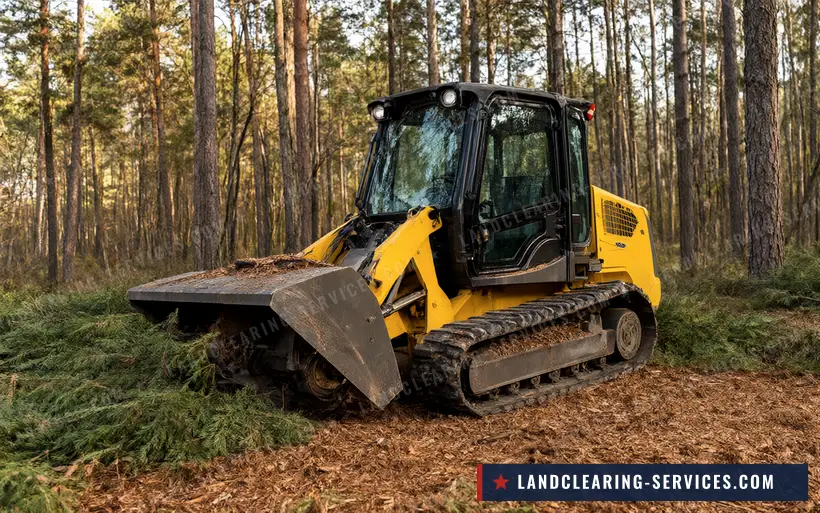
Skid steer mulcher
$2,500 to $3,200 a day, transport included inside 60 miles of the crew's yard.
Dedicated 300-hp mulcher
$3,800 to $4,500 a day plus transport for heavy timber or dense brush.
Forestry mulching services
$1,000 to $2,500 per acre for light to medium rose and brush; $2,500 to $4,000 per acre for dense stands.
Clear to dirt with stumps out
$2,500 to $6,000 per acre based on shale depth, slope, and root grubbing needs.
Dozer or excavator with operator
$150 to $200 per hour. Haul-off runs $600 to $1,300 per load if debris must leave the site.
Since 2019, field logs determine exact timing on our jobs. On a tract in Cherokee County, Georgia, we cleared 4 acres of dense privet and brush under pine using a skid steer mulcher over 2 days for $5,800. In West Virginia, shale ledges and steep grades add a day on site preparation and pad work. Review detailed pricing on our land-clearing cost page. Call (888) 709-7985 or send the form for a rapid response.
Land Clearing Cost Calculator for West Virginia
Planning range from 2025–2026 national price data, adjusted to West Virginia costs. Change any answer and the range updates.
Open the full land clearing cost calculatorBest Season to Mulch Trees in West Virginia
Winter provides an excellent window to clear vegetation across West Virginia hills. Frozen ground from December through March supports heavy machinery without tearing up mountain topsoil. Forestry mulchers operate effectively on frozen soil, grinding brush efficiently while trees are dormant and leaves are down. Trees blown over by storms leave fallen trees across your access trails. Frozen ground is the best road a mulcher ever drove on.
Grubbing, stump pulling, and dirt work must wait for the thaw. Mud season in March and April softens dirt tracks and adds a day to earthmoving operations. Summer brings dense canopy cover, while fall offers clean working conditions for clearing pasture, trail cutting, and lot prep before winter sets in.

West Virginia Permits, Burn Rules, Wetlands and Protected Trees
Understanding local rules protects property owners from unexpected delays. We review these regulations before moving equipment to your job site.
- 01
Burn rules
The West Virginia Division of Forestry director issues burning permits under W. Va. Code 20-3-5. Forest fire seasons run March 1 to May 31 and October 1 to December 31, during which outdoor burning is restricted to between 5 p.m. and 7 a.m. Commercial site burns require a $125 permit fee per site, though agricultural clearing activities are exempt.
- 02
Invasive species
The West Virginia Department of Agriculture lists autumn olive, Morrow's honeysuckle, Tartarian honeysuckle, multiflora rose, Japanese barberry, and kudzu as noxious weeds restricted from shipment without a commissioner permit.
- 03
Stormwater permits
A WVDEP stormwater construction permit is required when land disturbances reach or exceed 1 acre.
- 04
Wetlands
The US Army Corps of Engineers (Huntington and Pittsburgh Districts) regulates Section 404 permits for placing fill material in wetlands, streams, or low drainage areas.
- 05
Subdivision rules
Jefferson County and Berkeley County enforce local subdivision rules that impact access corridors and tree preservation during land development.
- 06
Utility clearance
Call 811 at least 48 hours before digging, excluding weekends and legal holidays, under W. Va. Code 24C-1-5.
- 07
Timber trespass
Under W. Va.
NRCS EQIP brush management cost-share under practice code 314 helps agricultural land and wildlife goals. Professional forestry mulching avoids open burning entirely while keeping soil intact.
Cost-Share Programs: NRCS EQIP Brush Management in West Virginia
Every landowner working to reclaim overgrown property can apply for funding through the USDA Natural Resources Conservation Service. The NRCS Environmental Quality Incentives Program (EQIP) provides financial assistance for brush management under practice code 314. This program targets invasive brush like multiflora rose, autumn olive, and tree of heaven.
Applications go through your county USDA service center. A conservation planner evaluates your tract and writes a detailed restoration plan specifying which brush to mow and which native wood to protect. Approval takes time, so file your application months before work starts. I've priced EQIP projects across 11 states by reviewing the planner's map and setting a fixed day rate that aligns with NRCS cost-share reimbursement rates.
Land Clearing Companies by West Virginia County and Metro
West Virginia recorded 3,618 single-family construction permits in 2025 according to the Census Building Permits Survey. Growth concentrates heavily in Eastern Panhandle counties servicing the Washington metro area, as well as college and resort corridors.
- 01
Jefferson County
1,213 single-family permits in 2025. Growth around Charles Town requires extensive lot clearing, driveway installation, and brush removal on karst limestone soil. Land clearing in Jefferson leads the state in volume. Demand for land clearing in West Virginia continues to grow near the state border.
- 02
Berkeley County
1,104 permits. High demand near Martinsburg for subdivision site prep, clearing for residential lots, and pasture reclamation.
- 03
Morgan County and Hampshire County
Morgan recorded 130 permits and Hampshire recorded 129 permits. Work involves steep ridge clearing, cabin sites, and clearing county land near Morgan forests.
- 04
Monongalia County
22 permits reported in Morgantown. Steep terrain, dense hardwoods, and rose thickets require specialized forestry mulchers.
- 05
Greenbrier County
100 permits around Lewisburg. Projects focus on pasture cleanup, farm fence lines, and estate building sites.
Whether you need land clearing near Jefferson or out in rural mountain counties, our crews bring heavy machinery directly to your line.
Send the Form, Get a Range the Same Day, Walk the Land with the West Virginia Crew
When we clear your land, work involves three simple steps. First, call (888) 709-7985 or fill out our form with your county, acreage total, and photos or description of the vegetation. Marisol in our estimating office emails a budget range the same day. Second, we schedule a free on-site estimate with our local equipment operators inside 60 miles of our nearest yard.
Our crew lead walks the tract to help property owners review boundary lines responsibly before work starts. Third, you receive a clear written proposal stating the machine day rate, estimated daily acreage production, and any terrain add-ons before equipment loads onto the trailer. Our forestry mulching and land clearing crews use equipment designed for steep ground. Call (888) 709-7985 today to reserve your field estimate.
Frequently Asked Questions About West Virginia Land Clearing
How much does land clearing cost per acre in West Virginia?
Forestry mulching costs $1,000 to $2,500 per acre for light to medium multiflora rose and autumn olive. Dense cover or heavy hardwood brush runs $2,500 to $4,000 per acre. Complete clearing to bare dirt with root grubbing runs $2,500 to $6,000 per acre depending on slope steepness and shale depth.
Do I need a permit to clear land in West Virginia?
Clearing brush on your own land does not require a state permit. However, if you clear 1 acre or more, you need a WVDEP stormwater construction permit. If you plan to burn brush piles, the West Virginia Division of Forestry director issues burning permits under W. Va. Code 20-3-5, with a $125 fee for commercial operations.
Can I burn brush piles after clearing my land?
Outdoor burning is allowed outside forest fire seasons. During fire seasons (March 1 to May 31 and October 1 to December 31), burning is restricted to 5 p.m. through 7 a.m. Commercial activities require a $125 permit from the Division of Forestry. Forestry mulching avoids burning entirely by grinding brush into a beneficial mulch layer.
When is the best time of year to clear property here?
Winter from December to March is ideal for forestry mulching because frozen ground supports heavy machinery without damaging thin hill soil. Dry fall weather is also excellent. Spring thaw during March and April creates mud that can add a day to ground-grubbing and dirt-moving operations.
How fast can a crew clear my land in West Virginia?
A half-acre residential building lot takes one day with a skid steer mulcher. Marisol provides a project timeline estimate the same day you submit your land details.
How do I get an environmentally responsible service quote?
Call (888) 709-7985 or fill out the website form with your project location, total acreage, and land restoration goals. Marisol emails a budget range the same day.
 Pricing guideLand clearing cost in West Virginia