Land Clearing Services in New Jersey: Phragmites Cleared on Lots and Acreage from Ocean to South Jersey
Work on New Jersey land starts with two facts: phragmites chokes every ditch along the coast, and high water tables in Pinelands sand can turn a heavy machine into an anchor if you pick the wrong week. I started on a dozer in Georgia red clay at 19, and after 20 years pricing site work across 11 states, the arithmetic here comes down to access, haul-off fees, and ground moisture. A skid steer mulcher runs $2,500 to $3,200 a day, transport included inside 60 miles of the crew's yard. Our crews clear lots, county land, and pads from Ocean County to Sussex. Send the form or call (888) 709-7985. Marisol emails a budget range the same day and books the estimate with the crew nearest you.
- 48 contiguous
states - Insured
crews - Same-day
budget range
48 statesContiguous coverage
$2,500–3,200Skid steer mulcher, per day
60 milesTransport included
Same dayBudget range by email
Land Clearing Services in New Jersey
Vegetation removal and brush work here come in seven distinct types, and we price every job by day or acre. Our professional land clearing experts also state what we do not do, so the list ends with that line.
Forestry mulching
one machine shreds standing trees and brush into a rich mulch layer that protects the soil against erosion. Professional forestry mulching runs $1,000 to $2,500 an acre for light to medium growth, avoiding high dump fees entirely.
Full site clearing
complete removal where crews grub stumps, root rake, and prepare dirt for new home construction or site prep. $2,500 to $6,000 per acre depending on rock and grading requirements.
Lot clearing
standard residential lot clearing for a half-acre lot usually takes one day, priced at $2,500 to $3,200.
Brush clearing
targeted work to clear vegetation like phragmites, autumn olive, and multiflora rose along fence lines and field edges.
Stump grinding
removing stumps below grade to grind wood per inch of diameter, with a $150 to $200 job minimum.
Tree removal and sapling clearing
selective work where we remove trees and small trees alongside dense brush for utility companies or private landowners.
Site prep and excavation
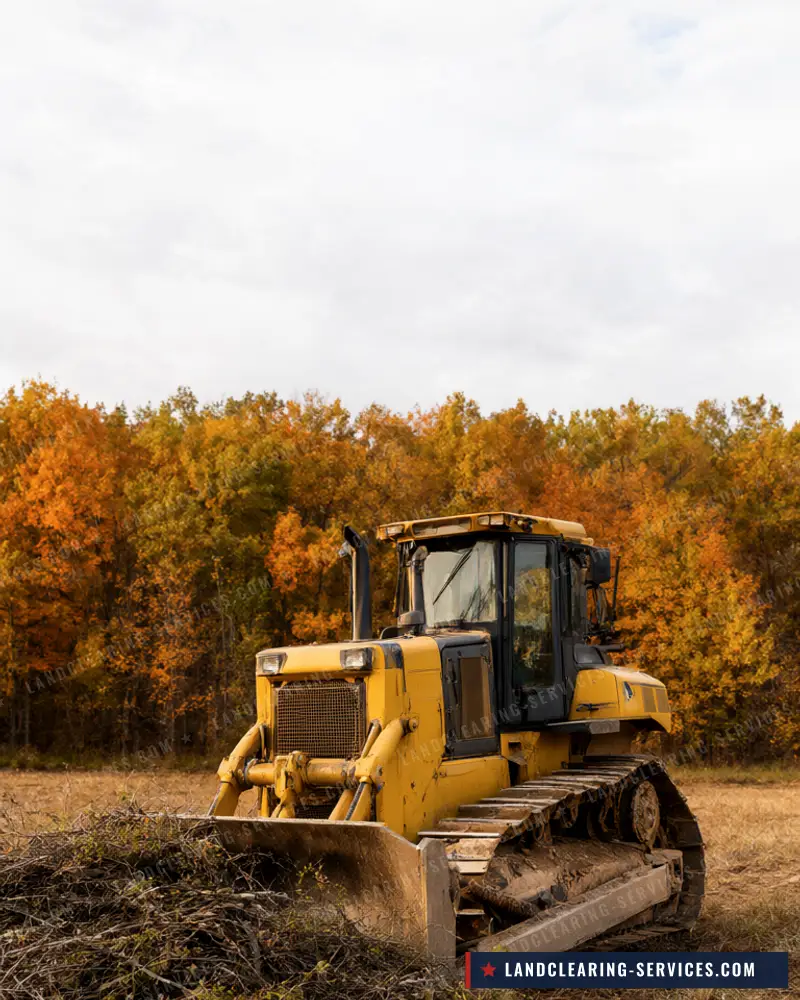
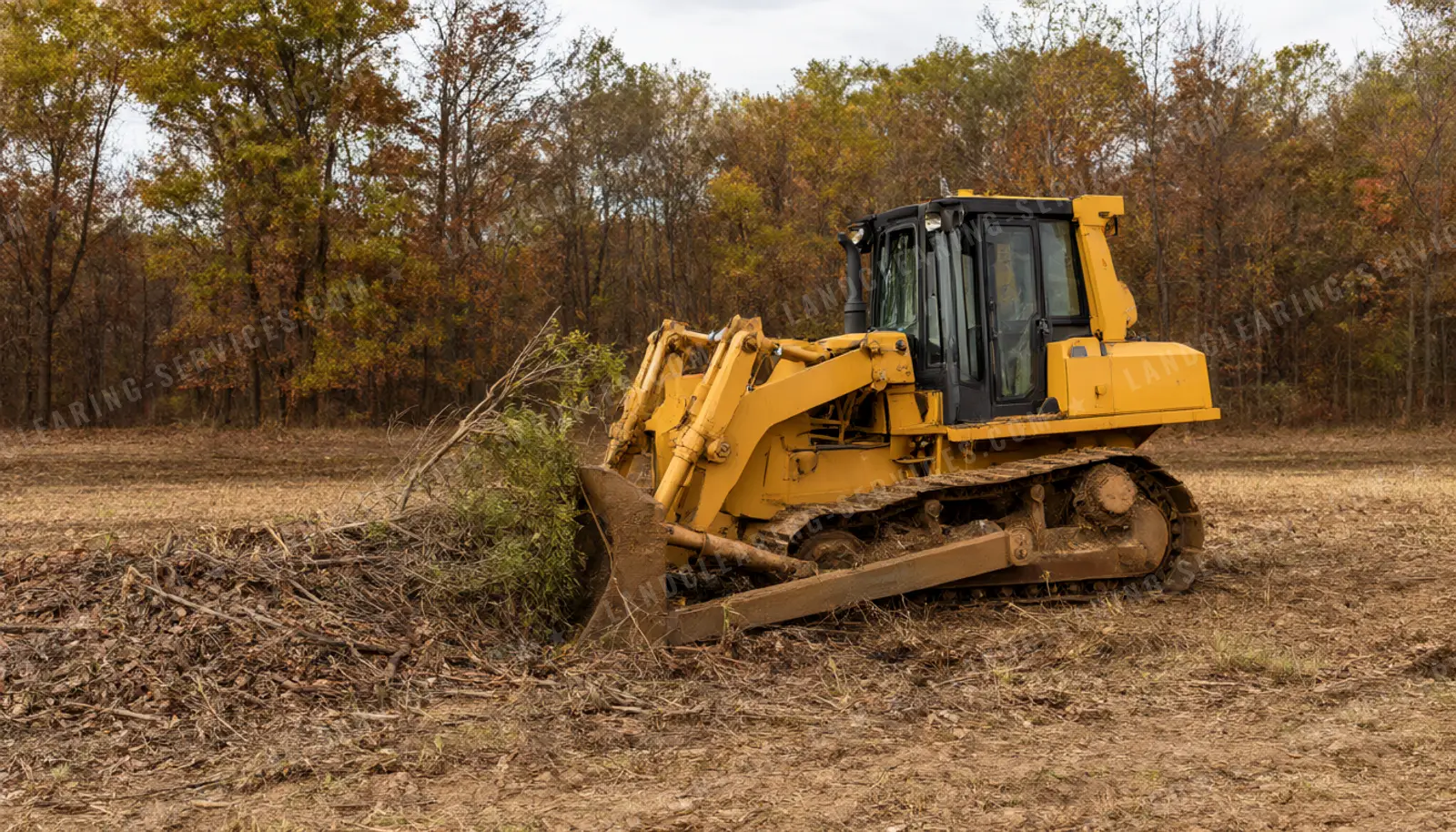
dozer or excavator work with an operator at $150 to $200 per hour for pads, a driveway, and rough grading.
We do not pour concrete, install septic fields, drill wells, or tear down structures. Clearline Land Services focuses strictly on clearing trees and brush so your builder can start on time. Reliable brush clearing contractors tell you that before the trailer moves.

Land Clearing Across New Jersey: Ocean, North Jersey, Central Jersey, and South Jersey
This state contains four distinct soil types, and each region dictates how a forestry mulching and land clearing company operates equipment.
contiguous states
- 01
Ocean County and Monmouth County (The Shore)
coastal plain sand with high water tables. Dense phragmites fills marsh borders while greenbrier and pitch pine cover inland lots. Forestry mulchers process this soft growth efficiently, though wetland setbacks must be respected.
- 02
North Jersey (Bergen, Morris, Sussex)
heavy clay, hardpan, and glacial till with significant rock ledges. Bittersweet, autumn olive, and porcelain berry cover abandoned fields. Pads here often require a rock day during dirt work.
- 03
Central Jersey (Burlington, Mercer, Middlesex)
Piedmont shale and agricultural loam. Multiflora rose, sweetgum, and invasive brush dominate overgrown pasture. Ideal ground for standard forestry mulching services and fast acreage production. Our crew clears thick overgrowth without disturbing underlying soil.
- 04
South Jersey and the Pinelands
deep sand and dense thickets of pitch pine and scrub oak. Pinelands Commission regulations govern clearing footprints, but the sandy ground lets forestry mulchers work year round without tracking deep ruts.
Every region functions as an active service area. Transport is fully included inside 60 miles of the crew's yard, keeping mobilizations straightforward for every project near Ocean County or up north.
What New Jersey Landowners Clear Most
Phragmites is the plant this state is embarrassed about along waterways and ditches, filling acreage rapidly if left unchecked. On upland fields across Central and North Jersey, multiflora rose, autumn olive, and Japanese knotweed dominate old pastures. Northern timber tracts frequently contend with heavy bittersweet vines pulling down healthy canopies. In the Pinelands, pitch pine and scrub oak require dense brush management, while residential infill lots often deal with stubborn bamboo thickets.
Minnesota buckthorn and New Jersey multiflora rose are the same job with different roots. When property owners need to manage brush, our forestry mulching preserves topsoil and suppresses regrowth. Traditional land clearing methods that push dirt often stir up buried seeds, leading to rapid invasive species resurgence. Shredding invasive brush down to ground level protects the soil while giving a landowner back their usable land. Pinelands sand is a sponge that eats tracks in wet weather.
Land Clearing Cost in New Jersey per Acre
New Jersey clearing costs reflect regional disposal fees and permit conditions, but production rates follow baseline equipment output. Here is the arithmetic on every estimate we write here.
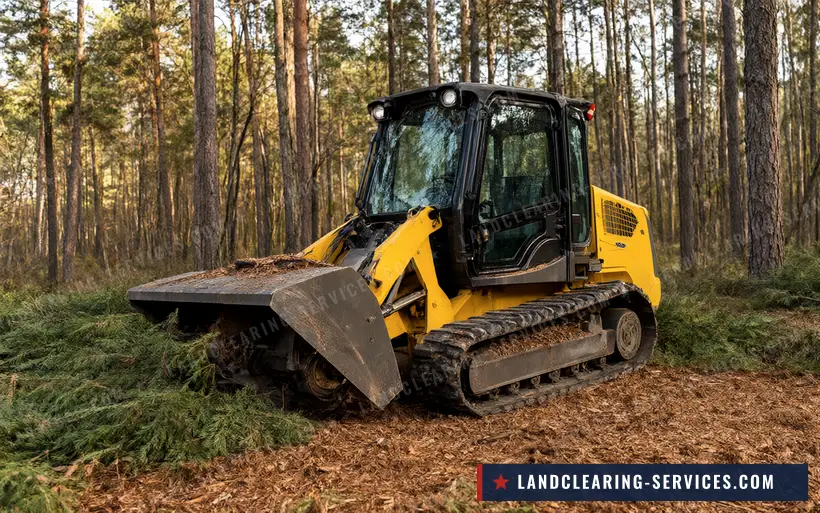
Skid steer mulcher
$2,500 to $3,200 per day, transport included inside 60 miles of the crew's yard.
Dedicated 300-hp mulcher
$3,800 to $4,500 per day plus transport for heavier timber and dense sapling stands.
Forestry mulching per acre
$1,000 to $2,500 for light to medium brush like phragmites or rose; $2,500 to $4,000 for dense, mature thickets.
Full clearing to dirt with stump grubbing
$2,500 to $6,000 per acre. Rock, steep slopes, and off-site hauling drive the top end.
Haul-off fees
$600 to $1,300 per load when local rules prohibit on-site burning or mulching.
On a job in the Hudson Valley nearby last winter, we cleared 1 acre of dense multiflora rose and buckthorn on frozen ground in a single day using a forestry mulcher for $3,100. On our jobs, we calculate the acres per day based on real stem density, not rough guesses. On a tract in Cherokee County last fall, we cleared 4 acres of privet under pine for $5,800 over two days. For a full breakdown, visit our dedicated New Jersey clearing cost page. Call (888) 709-7985 or submit the online form for a same-day budget estimate.
Land Clearing Cost Calculator for New Jersey
Planning range from 2025–2026 national price data, adjusted to New Jersey costs. Change any answer and the range updates.
Open the full land clearing cost calculatorBest Season to Clear Land in New Jersey
Frozen ground from December through March offers an exceptional window for clearing in New Jersey. Forestry mulchers float over frozen soil without tearing up turf or creating deep mud ruts. Equipment designed for low ground pressure operates at full speed when the earth is firm, allowing efficient work on frozen ground. Shredding invasive brush keeps fields from falling into heavy overgrow.
While mulching thrives in winter, heavy grubbing, root raking, and site cleanup wait for the spring thaw. The spring mud season in March and April adds a day to excavation schedules when soft ground slows track loaders. Land restoration works best when crews cut trails through wooded areas during dry weeks. Planning work for late fall or winter avoids mud delays and ensures land is cleared responsibly ahead of spring construction.
New Jersey Permits, Burn Rules, Wetlands, and Protected Trees
Navigating state and local rules before equipment arrives prevents costly delays and enforcement fines. I name these major requirements on the estimate so nobody meets them on a Monday.
- 01
811 Utility Markings
You must call 811 at least 3 full business days (excluding weekends and holidays) before digging, stump grubbing, or driving heavy machinery into unknown ground.
- 02
The NJ Forest Fire Service requires open burning permits, but vegetative debris burns are essentially unavailable in most townships. Hauling or burning rules make forestry mulching or off-site trucking the practical standard.
- 03
Freshwater Wetlands
The NJDEP Freshwater Wetlands Protection Act requires transition buffer zones ranging from 50 to 150 feet around mapped wetlands. Specialized regional oversight applies under the Pinelands Commission and Highlands Council.
- 04
USACE Section 404
Federal permits from either the Philadelphia District or New York District are mandatory if fill material enters regulated waters or streams.
- 05
Municipal Tree Ordinances
Most towns enforce strict tree removal rules, alongside state tree replacement mandates. Selective clearing helps fulfill local canopy retention ratios.
- 06
Invasive Plant Laws
Under the Invasive Species Management Act (signed January 8, 2026), the New Jersey Department of Agriculture maintains a Prohibited Invasive Plant List including Tree of heaven, Japanese barberry, Autumn olive, Winged burning bush, Amur honeysuckle, and Callery pear.
Cost-Share Programs: NRCS EQIP Brush Management in New Jersey
Private landowners managing agricultural acreage, timberland, or pasture can offset clearing expenses through federal conservation incentives. The Environmental Quality Incentives Program (EQIP), administered by the USDA Natural Resources Conservation Service (NRCS), offers brush management funding under practice code 314.
This program targets invasive brush control, land and wildlife habitat improvement, and pasture restoration. Landowners apply at their county USDA service center. An NRCS conservation planner evaluates the acreage and establishes an execution schedule. Once approved, our crews execute selective forestry mulching to clear targeted brush like autumn olive while preserving desirable hardwoods. This environmentally responsible approach protects topsoil while restoring pasture performance. We review your NRCS conservation plan to match equipment and clearing boundaries directly to program guidelines.
Land Clearing Companies by New Jersey County and Metro
According to the Census Building Permits Survey for 2025, New Jersey issued 12,820 single-family building permits. High housing demand drives steady commercial projects and clearing for residential site preparation across key growth counties.
- 01
Ocean County
2,372 single-family permits in 2025 (Toms River, Jackson, Lakewood). High demand for residential land clearing, phragmites removal, and building pad expansion in sandy soils. Land clearing in Ocean County keeps our crews busy year round.
- 02
Monmouth County
1,481 single-family permits in Monmouth County. Coastal infill lots and pasture reclamation requiring selective tree removal and brush management.
- 03
Burlington County & Gloucester County
946 and 706 permits respectively. Suburban growth expanding into agricultural edges, overgrown property, and brush fields.
- 04
Morris County & Sussex County
810 and 64 permits respectively. Residential sites in rocky terrain requiring expert land clearing and machine grading.
Whether you have an overgrown lot or a multi-acre commercial tract, our network delivers local equipment tailored to your ground. Land clearing near ocean county follows the same day-rate math as northern timber tracts.
Send the Form, Get a Range the Same Day, Walk the Land with the New Jersey Crew
Getting your ground cleared should be straightforward. First, call (888) 709-7985 or submit the online contact form with your property location, estimated acreage, and vegetation type. Marisol in our estimating office reviews the details and emails a budget range the same day. Next, we schedule a free estimate with the crew lead nearest you, inside 60 miles of a yard.
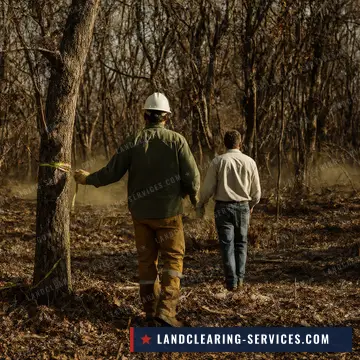
During the walk, we walked it with you to locate utility marks, identify wetland boundaries, and note structural obstacles like ledge, fallen trees, or buried debris. Property owners often ask us to mow dense brush or handle trail cutting across back acreage. You receive a final written bid outlining exact day rates, estimated acres per day based on acreage, and any extra days required for severe rock or soft mud. Insured crews arrive with equipment designed for tough terrain, including commercial forestry mulchers and dozers ready to work. Since 2019, Clearline Land Services has helped help property owners get clear pricing and dependable schedules. Professional land-clearing services and forestry mulching reclaim space while giving you your land back. Contact us today to clear your land efficiently.
Frequently Asked Questions
How much does land clearing cost per acre in New Jersey?
Forestry mulching costs $1,000 to $2,500 per acre for light brush like phragmites, and $2,500 to $4,000 per acre for thick timber and heavy rose. Full land clearing in New Jersey to bare dirt with stump removal runs $2,500 to $6,000 per acre depending on rock and hauling or burning rules.
Do I need a permit to clear brush in New Jersey?
You generally do not need a permit to cut brush on private high ground, but local municipal tree ordinances often apply. Projects near water require NJDEP freshwater wetland permits, and NJ Forest Fire Service open burning permit required regulations make debris burns essentially unavailable, so plan to mulch or haul.
Can I burn brush piles after clearing my land?
No, site prep debris burns are essentially unavailable under NJ Forest Fire Service open burning regulations. Most landowners use forestry mulching to grind brush into beneficial mulch on-site or hire us for haul-off trucking to an approved disposal facility.
What is the best time of year to clear vegetation here?
Winter from December to March is ideal for forestry mulchers because frozen ground supports heavy equipment without rutting soft soils. Dry summer months work well for root raking and full dirt clearing, while wet spring months can slow excavation work.
How fast can a clearing crew start on my tract?
Marisol emails a written budget range the same day you submit your request.
How do I get a clearing quote in New Jersey?
Call (888) 709-7985 or fill out our online form with your location and project size. Marisol emails a budget range the same day and arranges a free estimate with the local crew lead nearest your location.